
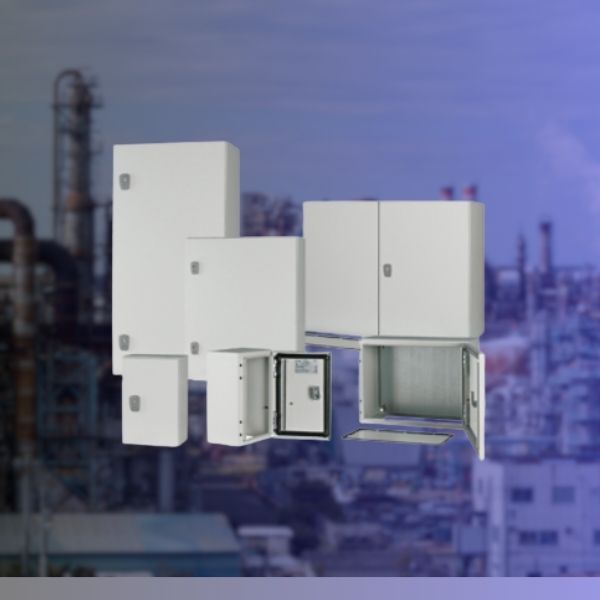
Selecting the right material for industrial enclosures is a critical decision that impacts equipment longevity, maintenance costs, and operational efficiency. The three most popular materials dominating the market today are Aluminum, Stainless Steel, and GRP (Glass Reinforced Plastic)/Fiberglass.
Each material brings unique characteristics to the table, and understanding their differences can save your organization thousands of dollars while ensuring optimal protection for sensitive equipment.
Understanding the Three Giants of Enclosure Materials
1. Aluminum Enclosures
Aluminum has emerged as a favorite choice for many industrial applications due to its exceptional balance of properties.
Key Characteristics:
- Lightweight yet remarkably strong
- Excellent thermal conductivity
- Natural corrosion resistance through oxide layer formation
- Highly machinable and customizable
- 100% recyclable material
Best Applications:
- Telecommunications equipment housing
- Electronic control panels
- Outdoor junction boxes
- Transportation and aerospace industries
- Areas requiring electromagnetic shielding
2. Stainless Steel Enclosures
When durability and maximum protection are non-negotiable, stainless steel stands as the premium choice.
Key Characteristics:
- Superior mechanical strength
- Exceptional corrosion resistance (especially 316 grade)
- High-temperature tolerance
- Hygienic and easy to clean
- Long service life with minimal maintenance
Best Applications:
- Food and beverage processing facilities
- Pharmaceutical manufacturing
- Chemical processing plants
- Marine and offshore installations
- Washdown environments
3. GRP/Fiberglass Enclosures
Glass Reinforced Plastic offers a compelling alternative when non-metallic properties are required.
Key Characteristics:
- Complete electrical insulation
- Excellent chemical resistance
- Lightweight construction
- UV resistant when properly formulated
- No thermal bridging
Best Applications:
- Water and wastewater treatment plants
- Solar and renewable energy installations
- Corrosive chemical environments
- Applications requiring non-conductivity
- Coastal and high-humidity areas
Head-to-Head Comparison: The Complete Analysis
Weight Comparison
| Material | Relative Weight | Impact on Installation |
|---|---|---|
| Aluminum | Light | Easy handling, lower shipping costs |
| Stainless Steel | Heavy | Requires sturdy mounting, higher logistics costs |
| GRP/Fiberglass | Lightest | Simplest installation, minimal support needed |
Corrosion Resistance Performance
Aluminum: Forms a protective oxide layer naturally. Performance can be enhanced through anodizing or powder coating. Susceptible to galvanic corrosion when in contact with dissimilar metals.
Stainless Steel: Grade 304 offers good general corrosion resistance. Grade 316 provides superior protection in marine and chloride-rich environments. Virtually immune to most industrial chemicals.
GRP/Fiberglass: Inherently corrosion-proof. Unaffected by most acids, alkalis, and solvents. Ideal for aggressive chemical environments where metals would fail.
Thermal Properties
| Property | Aluminum | Stainless Steel | GRP/Fiberglass |
|---|---|---|---|
| Thermal Conductivity | High | Moderate | Low |
| Heat Dissipation | Excellent | Good | Poor |
| Thermal Expansion | Moderate | Low | Variable |
Cost Analysis
Initial Purchase Cost:
- GRP/Fiberglass: $ (Most economical)
- Aluminum: $$ (Mid-range)
- Stainless Steel: $$$ (Premium pricing)
Long-Term Value:
Consider total cost of ownership including maintenance, replacement frequency, and operational efficiency rather than just initial purchase price.
Environmental Considerations for Material Selection
Outdoor Installations
For outdoor applications, consider these factors:
UV Exposure: GRP enclosures must have UV-stabilized formulations. Aluminum and stainless steel handle UV exposure without degradation.
Temperature Extremes: Stainless steel performs best in extreme heat applications. Aluminum provides good thermal management. GRP may have limitations in very high temperatures.
Precipitation and Humidity: All three materials can achieve high IP ratings when properly designed and sealed.
Indoor Industrial Environments
Cleanroom Requirements: Stainless steel leads due to its smooth, non-porous surface that resists bacterial growth.
Electrical Safety: GRP provides inherent electrical insulation, eliminating grounding requirements in certain applications.
Mechanical Strength and Impact Resistance
Comparative Strength Analysis
Stainless Steel offers the highest mechanical strength and impact resistance, making it ideal for high-traffic areas or applications where physical damage is likely.
Aluminum provides excellent strength-to-weight ratio. Modern aluminum alloys can match steel strength in many applications while remaining significantly lighter.
GRP/Fiberglass offers good impact resistance with the added benefit of returning to original shape after minor impacts. However, severe impacts may cause cracking rather than denting.
Electromagnetic Compatibility (EMC) Considerations
| Material | EMC Shielding | Applications |
|---|---|---|
| Aluminum | Excellent | Sensitive electronics, telecommunications |
| Stainless Steel | Very Good | Industrial controls, medical equipment |
| GRP/Fiberglass | None (without additives) | Non-sensitive applications, requires additional shielding if needed |
For applications requiring electromagnetic shielding, metallic enclosures provide inherent protection. GRP enclosures can be modified with conductive coatings or embedded mesh when EMC protection is necessary.
Maintenance Requirements and Longevity
Aluminum Enclosures
- Regular cleaning with mild detergent
- Inspect for galvanic corrosion at connection points
- Touch-up powder coating as needed
- Expected lifespan: 20-30 years with proper maintenance
Stainless Steel Enclosures
- Routine cleaning to prevent staining
- Passivation treatment after modifications
- Minimal maintenance requirements
- Expected lifespan: 30-50+ years
GRP/Fiberglass Enclosures
- Simple soap and water cleaning
- Inspect for UV degradation annually
- Check seal integrity regularly
- Expected lifespan: 20-25 years
Making the Right Choice: Decision Framework
Choose Aluminum When:
✓ Weight is a critical factor
✓ Good thermal dissipation is needed
✓ Electromagnetic shielding is required
✓ Budget is moderate
✓ Aesthetics matter
Choose Stainless Steel When:
✓ Maximum durability is essential
✓ Hygienic requirements exist
✓ Extreme temperatures are expected
✓ High-impact resistance is needed
✓ Long-term investment is prioritized
Choose GRP/Fiberglass When:
✓ Electrical insulation is mandatory
✓ Aggressive chemicals are present
✓ Budget is constrained
✓ Weight must be minimized
✓ Non-magnetic properties are required
Industry-Specific Recommendations
Oil and Gas Industry
Primary Choice: Stainless Steel 316
Alternative: GRP for non-structural applications
Food Processing
Primary Choice: Stainless Steel 304/316
Reason: Hygiene requirements and washdown capability
Telecommunications
Primary Choice: Aluminum
Reason: EMC shielding and thermal management
Water Treatment
Primary Choice: GRP/Fiberglass
Reason: Chemical resistance and cost efficiency
Renewable Energy
Primary Choice: GRP/Fiberglass or Aluminum
Reason: Lightweight, corrosion resistant, cost-effective
Future Trends in Enclosure Materials
The enclosure industry continues to evolve with several emerging trends:
- Hybrid Constructions: Combining materials to leverage individual strengths
- Advanced Coatings: Nano-coatings improving performance of all materials
- Sustainable Manufacturing: Focus on recyclability and reduced carbon footprint
- Smart Enclosures: Integration of monitoring systems regardless of material
Conclusion: Balancing Performance, Cost, and Application
There is no universally “best” enclosure material. The optimal choice depends on your specific application requirements, environmental conditions, budget constraints, and long-term operational considerations.
Aluminum strikes an excellent balance between performance and cost for general applications. Stainless Steel remains the gold standard for demanding environments requiring maximum protection. GRP/Fiberglass offers unique advantages where non-metallic properties are essential.
By carefully evaluating your needs against the characteristics outlined in this guide, you can confidently select the enclosure material that will provide optimal protection and value for your specific application.