
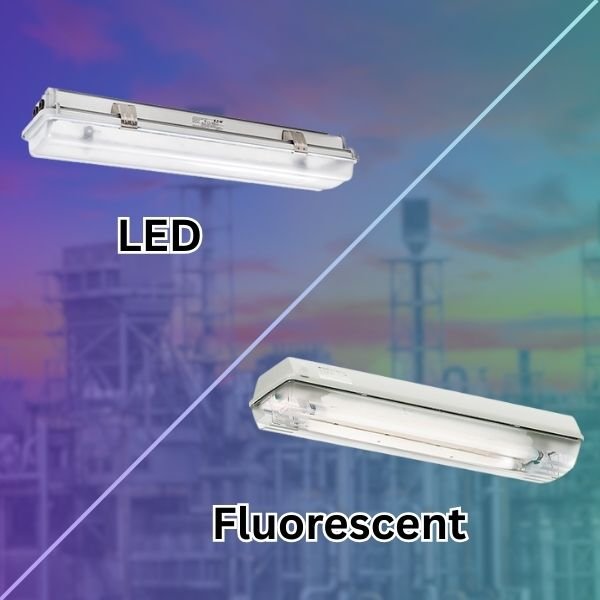
When it comes to hazardous area lighting, the stakes couldn’t be higher. A wrong lighting decision in explosive atmospheres can lead to catastrophic consequences, from equipment damage to loss of human lives. Industries such as oil and gas, chemical processing, mining, and pharmaceutical manufacturing must carefully evaluate their lighting options to ensure both operational efficiency and safety compliance.
This comprehensive guide examines the critical differences between LED (Light Emitting Diode) and fluorescent lighting technologies specifically designed for hazardous environments. We’ll analyze efficiency metrics, safety certifications, maintenance requirements, and total cost implications to help facility managers and safety engineers make informed decisions.
Understanding Hazardous Area Classifications
Before diving into the LED versus fluorescent comparison, it’s essential to understand the classification systems that govern hazardous area equipment.
ATEX and IECEx Zone Classifications
The European ATEX directive and the international IECEx certification scheme classify hazardous areas based on the frequency and duration of explosive atmosphere presence:
- Zone 0/20: Explosive atmosphere present continuously or for long periods
- Zone 1/21: Explosive atmosphere likely to occur during normal operations
- Zone 2/22: Explosive atmosphere unlikely during normal operations but may occur occasionally
NEC/CEC Division Classifications
North American standards use a different approach:
- Class I, Division 1: Hazardous concentrations exist under normal operating conditions
- Class I, Division 2: Hazardous concentrations exist only under abnormal conditions
- Class II: Combustible dust environments
- Class III: Ignitable fibers and flyings
LED Technology for Hazardous Areas: Technical Overview
How Explosion-Proof LED Fixtures Work
Modern explosion-proof LED fixtures incorporate several safety mechanisms:
- Flame-path technology: Precision-machined joints that cool escaping gases below ignition temperature
- Encapsulation: Complete sealing of electrical components in protective compounds
- Intrinsic safety circuits: Current and voltage limiting to prevent spark generation
- Thermal management systems: Advanced heat dissipation preventing dangerous surface temperatures
Key Specifications of Hazardous Area LED Lighting
| Parameter | Typical Range |
|---|---|
| Luminous Efficacy | 120-180 lumens per watt |
| Color Temperature | 4000K-6500K |
| CRI (Color Rendering Index) | 70-90+ |
| Operating Temperature | -40°C to +65°C |
| IP Rating | IP66/IP67/IP68 |
| Lifespan | 50,000-100,000 hours |
Fluorescent Technology for Hazardous Areas: Technical Overview
Construction of Explosion-Proof Fluorescent Fixtures
Fluorescent fixtures designed for hazardous locations typically feature:
- Heavy-duty cast aluminum or stainless steel housings
- Reinforced borosilicate or tempered glass tubes
- Explosion-proof ballast compartments
- Certified cable entry systems
Key Specifications of Hazardous Area Fluorescent Lighting
| Parameter | Typical Range |
|---|---|
| Luminous Efficacy | 50-100 lumens per watt |
| Color Temperature | 3000K-6500K |
| CRI (Color Rendering Index) | 62-85 |
| Operating Temperature | -20°C to +55°C |
| IP Rating | IP65/IP66 |
| Lifespan | 10,000-20,000 hours |
Energy Efficiency Comparison: The Numbers Don’t Lie
Power Consumption Analysis
One of the most significant advantages of LED technology in hazardous areas is its superior energy efficiency. Let’s examine a practical scenario:
Case Study: 100-Fixture Installation in a Chemical Processing Plant
| Metric | LED (40W equivalent) | Fluorescent (2x36W) |
|---|---|---|
| Power per fixture | 40W | 72W + 8W ballast loss |
| Total installation power | 4,000W | 8,000W |
| Daily operation (24 hours) | 96 kWh | 192 kWh |
| Annual consumption | 35,040 kWh | 70,080 kWh |
| Annual cost (@$0.12/kWh) | $4,205 | $8,410 |
| Annual savings with LED | $4,205 | – |
Luminous Efficacy Breakdown
LED technology delivers significantly more usable light per watt of electricity consumed:
- Premium LED fixtures: 150-180 lm/W
- Standard LED fixtures: 120-140 lm/W
- T8 Fluorescent: 80-100 lm/W
- T5 Fluorescent: 90-104 lm/W
This translates to a 40-80% improvement in energy efficiency when switching from fluorescent to LED technology.
Safety Performance in Explosive Atmospheres
Surface Temperature Considerations
Surface temperature is critical in hazardous areas where ignitable substances may contact lighting fixtures. Equipment is classified by temperature class:
| Temperature Class | Maximum Surface Temperature |
|---|---|
| T1 | 450°C |
| T2 | 300°C |
| T3 | 200°C |
| T4 | 135°C |
| T5 | 100°C |
| T6 | 85°C |
LED Advantage: LED fixtures typically achieve T4 or T5 ratings more easily due to lower heat generation, making them suitable for environments with lower ignition temperature substances like acetaldehyde or ethyl nitrite.
Fluorescent Limitation: Ballast components in fluorescent fixtures generate considerable heat, often limiting them to T3 or T4 classifications.
Impact and Vibration Resistance
| Factor | LED Performance | Fluorescent Performance |
|---|---|---|
| Solid-state construction | No filaments or glass tubes to break | Glass tubes vulnerable to breakage |
| Vibration tolerance | Excellent (no moving parts) | Poor to moderate |
| Impact resistance | High (IK08-IK10 ratings common) | Moderate (IK07-IK08 typical) |
| Shock loads | Withstands up to 100g | Limited tolerance |
Lifespan and Maintenance Requirements
Operational Lifespan Comparison
The difference in operational lifespan between LED and fluorescent technology is substantial:
- LED fixtures: 50,000-100,000 hours (L70 rating)
- Fluorescent tubes: 10,000-20,000 hours
- Fluorescent ballasts: 20,000-40,000 hours
Practical Implication: In a 24/7 operation, fluorescent tubes require replacement every 1-2 years, while LED fixtures can operate for 6-12 years before reaching their rated lifespan.
Maintenance Cost Analysis
Maintenance in hazardous areas is particularly costly due to:
- Permit-to-work requirements
- Hot work permits for certain zones
- Specialized technician qualifications
- Production shutdown needs
- Confined space entry protocols
Cost Comparison per Fixture (10-year period):
| Cost Element | LED | Fluorescent |
|---|---|---|
| Lamp replacements | $0 | $120-$180 |
| Ballast replacements | $0 | $80-$120 |
| Labor costs (skilled electrician) | $50 | $400-$600 |
| Permit and documentation | $20 | $150-$200 |
| Production downtime | Minimal | Significant |
| Total maintenance cost | ~$70 | $750-$1,100 |
Environmental Performance and Sustainability
Hazardous Material Content
Fluorescent lighting presents environmental challenges that LED technology avoids:
Fluorescent Concerns:
- Contains 3-5mg of mercury per tube
- Requires specialized disposal procedures
- Classified as hazardous waste in many jurisdictions
- Risk of mercury release if tubes break in hazardous areas
LED Advantages:
- No mercury content
- RoHS compliant
- Easier end-of-life recycling
- Reduced environmental liability
Carbon Footprint Reduction
Based on our 100-fixture installation example:
| Metric | LED | Fluorescent |
|---|---|---|
| Annual energy consumption | 35,040 kWh | 70,080 kWh |
| CO2 emissions (0.5 kg/kWh) | 17.5 tonnes | 35 tonnes |
| Annual CO2 reduction with LED | 17.5 tonnes | – |
Initial Investment and Total Cost of Ownership
Purchase Price Comparison
Explosion-proof LED fixtures typically carry a higher initial price tag:
| Fixture Type | Average Cost Range |
|---|---|
| LED explosion-proof linear | $400-$1,200 |
| LED explosion-proof high-bay | $600-$2,000 |
| Fluorescent explosion-proof linear | $250-$600 |
| Fluorescent explosion-proof high-bay | $350-$800 |
10-Year Total Cost of Ownership (TCO) Analysis
For a 100-fixture installation operating 24/7:
| Cost Category | LED Investment | Fluorescent Investment |
|---|---|---|
| Initial purchase | $80,000 | $40,000 |
| Installation | $15,000 | $15,000 |
| Energy costs (10 years) | $42,050 | $84,100 |
| Maintenance (10 years) | $7,000 | $85,000 |
| Replacement fixtures | $0 | $20,000 |
| Disposal costs | $500 | $3,000 |
| Total 10-Year TCO | $144,550 | $247,100 |
| TCO Savings with LED | $102,550 (41.5%) | – |
Performance in Extreme Conditions
Cold Temperature Operation
Many hazardous areas, such as LNG terminals and cold storage facilities, operate in extreme cold:
| Temperature Range | LED Performance | Fluorescent Performance |
|---|---|---|
| 0°C to -20°C | Excellent (100% output) | Reduced output (70-80%) |
| -20°C to -40°C | Very good (95-100% output) | Significant reduction (50-60%) |
| Below -40°C | Good with cold-rated models | Often non-functional |
LED Advantage: LEDs actually become more efficient in cold temperatures, while fluorescent technology struggles with starting and maintaining output.
Hot Temperature Operation
In high-temperature environments like refineries and foundries:
| Condition | LED Consideration | Fluorescent Consideration |
|---|---|---|
| Ambient 40-55°C | Requires thermal derating | Operates within limits |
| Ambient 55-65°C | High-temp rated fixtures needed | At operational limits |
| Ambient >65°C | Specialized cooling required | Not recommended |
Light Quality and Visibility Factors
Color Rendering for Safety
In hazardous industrial environments, accurate color perception is essential for:
- Identifying color-coded pipes and cables
- Reading warning labels and safety signs
- Detecting fluid leaks and contamination
- Monitoring equipment condition
| CRI Range | LED Availability | Fluorescent Availability |
|---|---|---|
| 70-79 | Standard | Standard |
| 80-89 | Common | Available |
| 90+ | Available | Rare and expensive |
Instant-On Capability
| Feature | LED | Fluorescent |
|---|---|---|
| Warm-up time | Instant (0 seconds) | 30-180 seconds |
| Restrike time | Instant | 30-60 seconds |
| Frequent switching impact | None | Reduces lifespan |
| Emergency response suitability | Excellent | Poor |
Smart Lighting Integration Possibilities
Industry 4.0 Compatibility
Modern LED hazardous area fixtures offer integration capabilities that fluorescent technology cannot match:
LED Smart Features:
- DALI (Digital Addressable Lighting Interface) compatibility
- Wireless connectivity (Bluetooth, Zigbee, proprietary protocols)
- Occupancy sensing integration
- Daylight harvesting
- Predictive maintenance monitoring
- Energy management system integration
Fluorescent Limitations:
- Basic on/off control only
- No native smart capabilities
- Limited dimming options
- No condition monitoring
Potential Additional Savings Through Smart Controls
| Control Strategy | Additional Energy Savings |
|---|---|
| Occupancy-based dimming | 20-40% |
| Daylight harvesting | 10-25% |
| Task tuning | 10-20% |
| Scheduled dimming | 15-30% |
| Combined strategies | Up to 60% |
Certification and Compliance Considerations
Required Certifications for Hazardous Areas
Both LED and fluorescent fixtures for hazardous areas must carry appropriate certifications:
| Region | Certification Body | Common Standards |
|---|---|---|
| Europe | ATEX notified bodies | EN 60079 series |
| International | IECEx | IEC 60079 series |
| North America | UL, CSA, FM | NEC Article 500-506 |
| Australia | ANZEx | AS/NZS 60079 series |
| Brazil | INMETRO | ABNT NBR IEC 60079 |
LED Certification Availability
LED explosion-proof fixtures are now widely available with full certifications for:
- Zone 1 and Zone 2 (Gas)
- Zone 21 and Zone 22 (Dust)
- Class I, Division 1 and Division 2
- Class II, Division 1 and Division 2
- Marine and offshore applications (IECEx, USCG, DNV-GL)
Making the Right Decision: Selection Criteria
When LED is the Clear Winner
Choose LED hazardous area lighting when:
- Energy costs are significant – High electricity rates or 24/7 operation
- Maintenance access is difficult – Offshore platforms, confined spaces, high-bay installations
- Cold environments – LNG facilities, refrigerated warehouses
- Instant-on is required – Emergency lighting, frequently switched areas
- Smart integration is planned – Industry 4.0 implementation
- Long-term investment – New facilities with 10+ year planning horizons
- Environmental compliance is priority – Mercury-free requirements
When Fluorescent Might Still Be Considered
Fluorescent may still be appropriate when:
- Budget constraints are severe – Limited initial capital
- Existing infrastructure supports fluorescent – Retrofit complexity
- Short-term installations – Temporary facilities
- Replacement parts availability – Remote locations with fluorescent supply chains
Frequently Asked Questions (FAQ)
Is LED lighting approved for Zone 1 hazardous areas?
Yes, LED lighting is fully approved for Zone 1 hazardous areas when properly certified. Modern explosion-proof LED fixtures carry ATEX, IECEx, and other regional certifications for Zone 1 applications. These fixtures incorporate flameproof enclosures (Ex d), increased safety construction (Ex e), or encapsulation (Ex m) protection methods.
How much energy can I save by switching from fluorescent to LED in hazardous areas?
Typical energy savings range from 40-60% when replacing fluorescent fixtures with equivalent LED alternatives. In a 24/7 industrial operation with 100 fixtures, this can translate to annual savings of $4,000-$6,000 in electricity costs alone, depending on local energy rates.
Do explosion-proof LED fixtures cost more than fluorescent?
Yes, explosion-proof LED fixtures typically cost 50-100% more upfront than equivalent fluorescent fixtures. However, the total cost of ownership over a 10-year period is significantly lower for LED due to reduced energy consumption, minimal maintenance requirements, and longer operational lifespan.
Can LED fixtures handle extreme temperatures in hazardous industrial environments?
LED fixtures perform excellently in cold temperatures, often improving efficiency below 0°C and remaining functional to -40°C or below with cold-rated models. For high-temperature applications above 55°C, specialized high-temperature LED fixtures are available, though thermal derating may apply.
How long do explosion-proof LED fixtures last compared to fluorescent?
Explosion-proof LED fixtures typically have a rated lifespan of 50,000-100,000 hours (L70), compared to 10,000-20,000 hours for fluorescent tubes. In practical terms, LED fixtures can operate for 6-12 years in 24/7 operations without replacement, while fluorescent tubes require replacement every 1-2 years.
Are LED fixtures safer than fluorescent in explosive atmospheres?
LED fixtures offer several safety advantages: lower surface temperatures (easier T5/T6 classification), no fragile glass tubes that could shatter and cause ignition sources, solid-state construction resistant to vibration, and instant-on capability for emergency situations. Both technologies, when properly certified, meet safety requirements for hazardous areas.
Conclusion: The Verdict on Efficiency
After comprehensive analysis, LED technology emerges as the clear winner for hazardous area lighting efficiency. The advantages extend across multiple dimensions:
Energy Efficiency: 40-60% reduction in power consumption
Maintenance Efficiency: 80-90% reduction in maintenance costs
Operational Efficiency: Instant-on capability, superior light quality
Environmental Efficiency: Mercury-free, reduced carbon footprint
Financial Efficiency: 40%+ reduction in 10-year total cost of ownership
While fluorescent technology served hazardous industries well for decades, the maturation of LED technology for explosive atmospheres has created a compelling case for transition. The higher initial investment is recovered through energy savings within 2-4 years, with continued savings for the remainder of the fixture’s extended lifespan.
For facility managers, safety engineers, and procurement professionals responsible for hazardous area lighting decisions, LED technology represents not just an efficiency upgrade, but a fundamental improvement in safety, sustainability, and operational excellence.