
You’ve identified that your facility has a Zone 1 hazardous area. You know you need explosion-protected equipment. But when you open a supplier catalog, you’re confronted with cryptic codes: “Ex d IIB T4 Gb” or “Ex ia IIC T6 Ga.” What do all these letters and numbers mean?
Two of the most critical—yet frequently misunderstood—parameters in hazardous area equipment selection are Gas Group and Temperature Class. Get these wrong, and your certified “explosion-proof” equipment could become the very ignition source it was designed to prevent.
This article provides a complete, practical guide to understanding Gas Groups (IIA, IIB, IIC) and Temperature Classes (T1-T6), with clear selection criteria and real-world examples.
Why Do Gas Groups and Temperature Classes Matter?
Every flammable gas or vapor has unique properties that determine:
- How easily it ignites (ignition energy, flame propagation)
- At what temperature it self-ignites (auto-ignition temperature)
Equipment designed to prevent explosions must account for these properties. A piece of equipment safe for use with methane might be completely inadequate for hydrogen. Similarly, equipment rated for 200°C surface temperature is dangerous in an atmosphere that auto-ignites at 180°C.
The fundamental rule:
Equipment must be certified for a Gas Group at least as severe as the gases present, AND a Temperature Class with a maximum surface temperature below the auto-ignition temperature of those gases.
Part 1: Gas Groups Explained
What Determines a Gas Group?
Gas Groups classify flammable gases and vapors based on two key properties that indicate how “difficult” they are to contain:
1. Maximum Experimental Safe Gap (MESG)
The MESG is the maximum gap width (in millimeters) in a standardized test apparatus through which a flame cannot propagate from an internal explosion to an external explosive atmosphere.
- Smaller MESG = More dangerous gas = Flame can propagate through smaller gaps
- Larger MESG = Less dangerous gas = Flame needs larger gaps to propagate
2. Minimum Igniting Current (MIC) Ratio
The MIC Ratio compares the minimum current required to ignite a gas versus the current needed to ignite methane (the reference gas).
- Lower MIC Ratio = Easier to ignite = More dangerous
- Higher MIC Ratio = Harder to ignite = Less dangerous
The Three Equipment Groups
Before diving into IIA, IIB, and IIC, understand that the IEC system has three main Equipment Groups:
| Equipment Group | Application |
|---|---|
| Group I | Mining (firedamp/methane in underground coal mines) |
| Group II | Surface industries (all other flammable gases and vapors) |
| Group III | Combustible dusts |
Group II is further subdivided into IIA, IIB, and IIC based on gas properties.
Gas Group IIA: The “Easiest” Gases
Characteristics
| Parameter | Value |
|---|---|
| MESG | > 0.9 mm |
| MIC Ratio | > 0.8 |
| Danger Level | Lowest (within Group II) |
| Equipment Cost | Least expensive |
Representative Gases
| Gas/Vapor | MESG (mm) | MIC Ratio | Auto-Ignition Temp |
|---|---|---|---|
| Methane | 1.14 | 1.00 | 595°C |
| Propane | 0.92 | 0.82 | 450°C |
| Butane | 0.98 | 0.82 | 365°C |
| Gasoline (Petrol) | ~0.91 | ~0.82 | 280°C |
| Acetone | 1.04 | 0.88 | 465°C |
| Ammonia | 3.17 | 0.89 | 630°C |
| Benzene | 0.99 | 0.88 | 498°C |
| Diesel | ~1.0 | ~0.85 | 225°C |
| Hexane | 0.93 | 0.88 | 225°C |
| Methanol | 0.92 | 0.89 | 385°C |
| Toluene | 1.00 | 0.88 | 480°C |
Common Applications
- Natural gas processing and distribution
- Oil refineries (general process areas)
- Petrochemical plants
- Gasoline storage and dispensing (petrol stations)
- LPG storage facilities
- Paint and coating manufacturing
Equipment Marking Example
Ex d IIA T3 GbMeaning: Flameproof enclosure, suitable for Group IIA gases, Temperature Class T3, EPL Gb (Zone 1)
Gas Group IIB: The “Intermediate” Gases
Characteristics
| Parameter | Value |
|---|---|
| MESG | 0.5 – 0.9 mm |
| MIC Ratio | 0.45 – 0.8 |
| Danger Level | Moderate |
| Equipment Cost | Higher than IIA |
Representative Gases
| Gas/Vapor | MESG (mm) | MIC Ratio | Auto-Ignition Temp |
|---|---|---|---|
| Ethylene | 0.65 | 0.66 | 425°C |
| Ethyl Ether (Diethyl Ether) | 0.87 | 0.54 | 160°C |
| Hydrogen Sulfide (H₂S) | 0.71 | 0.66 | 260°C |
| Ethanol | 0.89 | 0.79 | 363°C |
| Carbon Monoxide | 0.84 | 0.65 | 605°C |
| 1,3-Butadiene | 0.79 | 0.79 | 415°C |
| Ethylene Oxide | 0.59 | 0.54 | 429°C |
| Acrylonitrile | 0.87 | 0.69 | 481°C |
Important Note on IIB
Some gases classified as IIB are borderline and require careful attention:
- Ethylene is the “benchmark” IIB gas
- Hydrogen Sulfide (H₂S) appears in oil and gas operations frequently
- Diethyl Ether has an extremely low auto-ignition temperature (160°C), requiring careful temperature class selection
Common Applications
- Ethylene production plants
- Sour gas processing (H₂S-containing)
- Pharmaceutical manufacturing (ether-based solvents)
- Chemical synthesis facilities
- Coal gasification plants
Equipment Marking Example
Ex de IIB T4 GbMeaning: Flameproof + Increased Safety, suitable for Group IIB gases (also covers IIA), Temperature Class T4, EPL Gb
Gas Group IIC: The “Most Dangerous” Gases
Characteristics
| Parameter | Value |
|---|---|
| MESG | < 0.5 mm |
| MIC Ratio | < 0.45 |
| Danger Level | Highest |
| Equipment Cost | Most expensive |
Representative Gases
| Gas/Vapor | MESG (mm) | MIC Ratio | Auto-Ignition Temp |
|---|---|---|---|
| Hydrogen (H₂) | 0.29 | 0.21 | 560°C |
| Acetylene (C₂H₂) | 0.37 | 0.17 | 305°C |
| Carbon Disulfide (CS₂) | 0.34 | 0.29 | 95°C |
Why Are These Gases So Dangerous?
- Hydrogen:
- Smallest molecule—can leak through microscopic gaps
- Extremely low ignition energy (0.017 mJ vs. 0.28 mJ for methane)
- Flames propagate through gaps as small as 0.29 mm
- Invisible flame
- Acetylene:
- Can decompose explosively even without oxygen
- Extremely reactive
- Used extensively in welding operations
- Carbon Disulfide:
- Extraordinarily low auto-ignition temperature (95°C)
- A hot steam pipe can ignite it
- Requires T6 temperature class equipment
Common Applications
- Hydrogen production and storage
- Fuel cell facilities
- Ammonia synthesis plants (hydrogen is a feedstock)
- Chlor-alkali plants (hydrogen byproduct)
- Welding shops with acetylene storage
- Rayon/viscose fiber manufacturing (carbon disulfide)
Equipment Marking Example
Ex ia IIC T6 GaMeaning: Intrinsically Safe (highest level), suitable for Group IIC gases (covers all gases), Temperature Class T6, EPL Ga (Zone 0)
Gas Group Hierarchy: The Compatibility Rule
A critical concept is that higher gas groups cover lower ones:
┌─────────────────────────────────────────────┐
│                    IIC                      │
│  ┌───────────────────────────────────────┐  │
│  │                IIB                    │  │
│  │  ┌─────────────────────────────────┐  │  │
│  │  │              IIA                │  │  │
│  │  │                                 │  │  │
│  │  │   Methane, Propane, Gasoline    │  │  │
│  │  │                                 │  │  │
│  │  └─────────────────────────────────┘  │  │
│  │                                       │  │
│  │   Ethylene, H₂S, Diethyl Ether        │  │
│  │                                       │  │
│  └───────────────────────────────────────┘  │
│                                             │
│   Hydrogen, Acetylene, Carbon Disulfide     │
│                                             │
└─────────────────────────────────────────────┘
Practical Meaning:
| Equipment Certified For | Can Be Used With |
|---|---|
| IIC | IIC, IIB, and IIA gases |
| IIB | IIB and IIA gases only |
| IIA | IIA gases only |
Example: A pump rated “Ex d IIC T4” can be safely used in methane (IIA), ethylene (IIB), AND hydrogen (IIC) atmospheres—provided the temperature class is appropriate.
Gas Group Selection Guide
Step 1: Identify ALL flammable gases/vapors that may be present in the area.
Step 2: Look up the gas group for each substance.
Step 3: Select equipment rated for the most severe gas group present.
| Gases Present | Required Equipment Rating |
|---|---|
| Only IIA gases | IIA (minimum) |
| Any IIB gas present | IIB (minimum) |
| Any IIC gas present | IIC (mandatory) |
| Unknown or mixed | IIC (safest choice) |
Part 2: Temperature Classes Explained
What is Auto-Ignition Temperature (AIT)?
The Auto-Ignition Temperature (AIT) is the minimum temperature at which a substance will spontaneously ignite in air without an external ignition source (spark or flame).
| Substance | Auto-Ignition Temperature |
|---|---|
| Carbon Disulfide | 95°C |
| Diethyl Ether | 160°C |
| Diesel | 225°C |
| Gasoline | 280°C |
| Methane | 595°C |
Critical Point: If any equipment surface reaches or exceeds the AIT of the surrounding atmosphere, spontaneous ignition occurs—even without any spark.
Temperature Classes (T-Classes)
Temperature Classes define the maximum surface temperature that equipment can reach during operation. Equipment must be selected so its T-Class ensures surfaces stay below the AIT of all gases present.
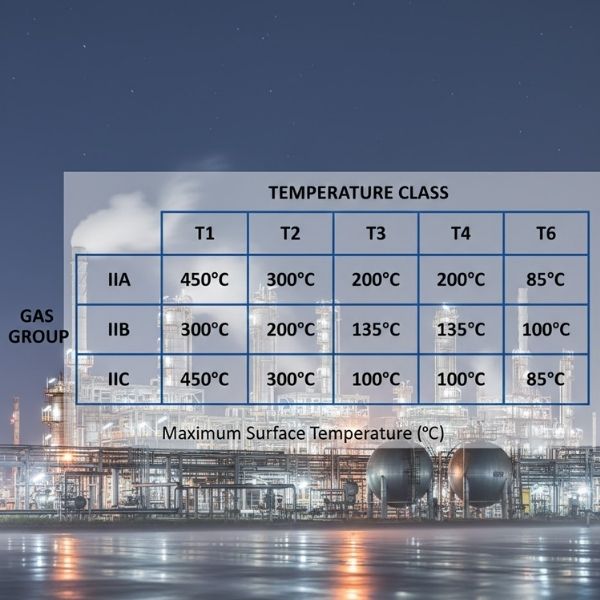
IEC Temperature Class Table
| T-Class | Maximum Surface Temperature | Minimum AIT of Gas Required |
|---|---|---|
| T1 | 450°C (842°F) | > 450°C |
| T2 | 300°C (572°F) | > 300°C |
| T3 | 200°C (392°F) | > 200°C |
| T4 | 135°C (275°F) | > 135°C |
| T5 | 100°C (212°F) | > 100°C |
| T6 | 85°C (185°F) | > 85°C |
Sub-Classes (Additional Precision)
Some applications require finer temperature distinctions:
| T-Class | Max Surface Temp |
|---|---|
| T2A | 280°C |
| T2B | 260°C |
| T2C | 230°C |
| T2D | 215°C |
| T3A | 180°C |
| T3B | 165°C |
| T3C | 160°C |
| T4A | 120°C |
Visual Representation
Temperature Scale (°C)

  T1 ─────┬───── 450°C ─── Methane (595°C) ✓
          │
  T2 ─────┼───── 300°C ─── Ethylene (425°C) ✓
          │                Gasoline (280°C) ✗ (too close!)
  T3 ─────┼───── 200°C ─── Gasoline (280°C) ✓
          │                Diesel (225°C) ✓
  T4 ─────┼───── 135°C ─── Diethyl Ether (160°C) ✓
          │
  T5 ─────┼───── 100°C ─── Carbon Disulfide (95°C) ✗
          │
  T6 ─────┴───── 85°C ──── Carbon Disulfide (95°C) ✓

✓ = Safe     ✗ = Dangerous
Temperature Class Hierarchy
Like gas groups, lower T-classes are more restrictive and cover higher ones:
┌─────────────────────────────────────────────┐
│                    T6 (85°C)                │
│  ┌───────────────────────────────────────┐  │
│  │              T5 (100°C)               │  │
│  │  ┌─────────────────────────────────┐  │  │
│  │  │           T4 (135°C)            │  │  │
│  │  │  ┌───────────────────────────┐  │  │  │
│  │  │  │        T3 (200°C)         │  │  │  │
│  │  │  │  ┌─────────────────────┐  │  │  │  │
│  │  │  │  │     T2 (300°C)      │  │  │  │  │
│  │  │  │  │  ┌───────────────┐  │  │  │  │  │
│  │  │  │  │  │   T1 (450°C)  │  │  │  │  │  │
│  │  │  │  │  └───────────────┘  │  │  │  │  │
│  │  │  │  └─────────────────────┘  │  │  │  │
│  │  │  └───────────────────────────┘  │  │  │
│  │  └─────────────────────────────────┘  │  │
│  └───────────────────────────────────────┘  │
└─────────────────────────────────────────────┘
Practical Meaning:
| Equipment T-Class | Suitable for Gases with AIT > |
|---|---|
| T1 | 450°C |
| T2 | 300°C |
| T3 | 200°C |
| T4 | 135°C |
| T5 | 100°C |
| T6 | 85°C (All gases) |
Example: Equipment rated T4 (135°C max) is safe for:
- Gasoline (AIT 280°C) ✓
- Ethylene (AIT 425°C) ✓
- But NOT for Diethyl Ether (AIT 160°C)… wait, 160°C > 135°C, so it’s actually ✓
Temperature Class Selection Guide
Step 1: Identify ALL flammable gases/vapors in the area.
Step 2: Find the lowest AIT among them.
Step 3: Select equipment with a T-Class that ensures maximum surface temperature is below that AIT.
Step 4: Apply a safety margin (typically equipment T-Class should be 20-50°C below AIT).
| Lowest AIT in Area | Recommended T-Class |
|---|---|
| > 450°C | T1 (or any) |
| 300 – 450°C | T2 (minimum) |
| 200 – 300°C | T3 (minimum) |
| 135 – 200°C | T4 (minimum) |
| 100 – 135°C | T5 (minimum) |
| 85 – 100°C | T6 (mandatory) |
| < 85°C | Special engineering required |
Combining Gas Group and Temperature Class
Equipment selection requires BOTH parameters to be appropriate. Here’s a practical selection matrix:
Common Industrial Gases: Quick Reference
| Gas/Vapor | Gas Group | AIT (°C) | Minimum T-Class |
|---|---|---|---|
| Acetone | IIA | 465 | T1 |
| Acetylene | IIC | 305 | T2 |
| Ammonia | IIA | 630 | T1 |
| Benzene | IIA | 498 | T1 |
| Butane | IIA | 365 | T2 |
| Carbon Disulfide | IIC | 95 | T6 |
| Carbon Monoxide | IIB | 605 | T1 |
| Diesel | IIA | 225 | T3 |
| Diethyl Ether | IIB | 160 | T4 |
| Ethanol | IIB | 363 | T2 |
| Ethylene | IIB | 425 | T2 |
| Ethylene Oxide | IIB | 429 | T2 |
| Gasoline (Petrol) | IIA | 280 | T3 |
| Hexane | IIA | 225 | T3 |
| Hydrogen | IIC | 560 | T1 |
| Hydrogen Sulfide | IIB | 260 | T3 |
| Methane | IIA | 595 | T1 |
| Methanol | IIA | 385 | T2 |
| Propane | IIA | 450 | T2 |
| Toluene | IIA | 480 | T1 |
Practical Examples: Complete Equipment Selection
Example 1: Natural Gas Compressor Station
Hazardous Substance: Methane (natural gas)
| Parameter | Value | Equipment Requirement |
|---|---|---|
| Gas Group | IIA | Equipment rated IIA (minimum) |
| AIT | 595°C | T1 would suffice |
| Zone | Zone 1 (near compressor seals) | EPL Gb minimum |
Equipment Selection: Ex d IIA T3 Gb
(T3 provides extra safety margin and is commonly available)
Example 2: Gasoline Loading Terminal
Hazardous Substance: Gasoline vapors
| Parameter | Value | Equipment Requirement |
|---|---|---|
| Gas Group | IIA | Equipment rated IIA (minimum) |
| AIT | 280°C | T3 (200°C) required minimum |
| Zone | Zone 1 (loading arms) | EPL Gb minimum |
Equipment Selection: Ex de IIA T3 Gb
Warning: T2 equipment (300°C max) would be marginal—only 20°C safety margin. T3 is strongly recommended.
Example 3: Ethylene Production Plant
Hazardous Substance: Ethylene
| Parameter | Value | Equipment Requirement |
|---|---|---|
| Gas Group | IIB | Equipment rated IIB (minimum) |
| AIT | 425°C | T2 would suffice |
| Zone | Zone 1 | EPL Gb minimum |
Equipment Selection: Ex d IIB T3 Gb
Example 4: Hydrogen Fuel Cell Facility
Hazardous Substance: Hydrogen
| Parameter | Value | Equipment Requirement |
|---|---|---|
| Gas Group | IIC | Equipment rated IIC (mandatory) |
| AIT | 560°C | T1 would suffice |
| Zone | Zone 1 | EPL Gb minimum |
Equipment Selection: Ex d IIC T3 Gb
(IIC-rated equipment is essential; T3 is common standard)
Example 5: Pharmaceutical Plant with Diethyl Ether
Hazardous Substance: Diethyl Ether
| Parameter | Value | Equipment Requirement |
|---|---|---|
| Gas Group | IIB | Equipment rated IIB (minimum) |
| AIT | 160°C | T4 (135°C) required |
| Zone | Zone 1 | EPL Gb minimum |
Equipment Selection: Ex d IIB T4 Gb
Critical Note: T3 equipment (200°C max) would be DANGEROUS here. The 40°C margin is insufficient and does not account for temperature spikes.
Example 6: Carbon Disulfide Processing (Rayon Manufacturing)
Hazardous Substance: Carbon Disulfide
| Parameter | Value | Equipment Requirement |
|---|---|---|
| Gas Group | IIC | Equipment rated IIC (mandatory) |
| AIT | 95°C | T6 (85°C) required |
| Zone | Zone 1 | EPL Gb minimum |
Equipment Selection: Ex ia IIC T6 Ga
Extreme Precaution: This is one of the most dangerous industrial atmospheres. Even T5 (100°C) equipment is too hot. Intrinsically safe equipment is often preferred over flameproof due to zero-energy design.
Common Mistakes and How to Avoid Them
Mistake 1: Selecting Based on “Primary” Gas Only
Problem: A facility handles methane (IIA) but also has trace hydrogen (IIC) from a side reaction.
Wrong Approach: Specifying IIA equipment because “methane is the main gas.”
Correct Approach: ALL gases must be considered. If ANY IIC gas is present, IIC equipment is required.
Mistake 2: Ignoring Temperature Derating
Problem: Equipment is rated T3 (200°C max) at 40°C ambient. Facility operates in a desert where ambient reaches 55°C.
Risk: Equipment surface temperature may exceed rated value at higher ambient temperatures.
Solution: Request temperature class rating at actual maximum ambient, or select a lower T-class (T4 instead of T3).
Mistake 3: Confusing AIT with Flash Point
| Term | Definition | Relevance |
|---|---|---|
| Flash Point | Minimum temperature at which liquid produces ignitable vapor | Determines if substance is flammable at ambient conditions |
| Auto-Ignition Temp | Temperature at which substance ignites spontaneously | Determines required T-Class |
Example: Diesel has a flash point of ~52°C but an AIT of 225°C. T3 equipment is required based on AIT, not flash point.
Mistake 4: Assuming “Explosion Proof” Means Universal Protection
Problem: Installing “explosion proof” equipment without checking gas group and T-class compatibility.
Reality: A light fixture rated “Ex d IIA T2” is NOT safe in a hydrogen (IIC) atmosphere or where gasoline vapors (AIT 280°C, needs T3) are present.
Summary: Quick Selection Checklist
Before Selecting Equipment:
☐ Identify all hazardous gases/vapors that may be present
☐ Determine Gas Group for each substance (IIA, IIB, or IIC)
☐ Find Auto-Ignition Temperature for each substance
☐ Determine Zone classification (0, 1, or 2)
☐ Consider ambient temperature and any process heat sources
Equipment Selection Rules:
| Gas Group | Equipment Must Be Rated |
|---|---|
| Only IIA gases | IIA or higher |
| Any IIB gas | IIB or higher |
| Any IIC gas | IIC only |
| Lowest AIT | Equipment Must Be Rated |
|---|---|
| > 450°C | T1 or lower |
| 300-450°C | T2 or lower |
| 200-300°C | T3 or lower |
| 135-200°C | T4 or lower |
| 100-135°C | T5 or lower |
| 85-100°C | T6 only |
Conclusion
Understanding Gas Groups (IIA, IIB, IIC) and Temperature Classes (T1-T6) is fundamental to selecting appropriate explosion-protected equipment. These parameters directly correlate to the physical properties of flammable substances—specifically, how easily flames propagate and at what temperature self-ignition occurs.
Key Takeaways:
- Gas Groups are based on MESG and MIC ratio—IIC is most dangerous, IIA is least.
- Temperature Classes ensure equipment surfaces stay below auto-ignition temperatures—T6 is most restrictive, T1 is least.
- Higher ratings cover lower ones: IIC equipment works for all gases; T6 equipment works for all temperatures.
- Both parameters must be correct: Wrong gas group OR wrong T-class can cause explosions.
- When in doubt, go higher: IIC T6 equipment provides maximum protection but at higher cost.
The cost difference between correctly rated and incorrectly rated equipment is insignificant compared to the cost of an explosion. Invest in proper engineering assessment and equipment selection.