
In the volatile world of oil, gas, and chemical processing, a single spark can lead to catastrophe. To mitigate this risk, engineers rely on specific protection concepts defined by international standards (IEC/ATEX). Among the most robust and widely used is Type “d” Protection, commonly known as Flameproof or Explosion Proof.
But what exactly happens inside an Ex d enclosure? Does it seal out gas completely? Does it prevent explosions entirely? The answers might surprise you.
This guide breaks down the working principles, the critical “flame path” concept, and the real-world applications of Ex d protection.
What is Type “d” Protection (Ex d)?
Type “d”, governed by standard IEC 60079-1, is a method of protection where electrical parts that could ignite an explosive atmosphere are placed inside an enclosure.
Contrary to popular belief, an Ex d enclosure is not designed to be gas-tight. It is assumed that explosive gas or vapor will eventually penetrate the enclosure through breathing devices or interface gaps.
Definition: An enclosure capable of withstanding an internal explosion of a flammable gas or vapor that may enter it, without suffering damage and without communicating the internal flame to the external explosive atmosphere.
The Working Principle: Containment and Cooling
The genius of the Ex d design lies not in preventing the explosion, but in containing and neutralizing it.
1. Mechanical Strength (Containment)
The enclosure acts as a pressure vessel. It must be mechanically strong enough (usually constructed from cast iron, aluminum alloy, or stainless steel) to withstand the peak pressure generated by an internal explosion without rupturing or permanently deforming.
2. The Flame Path (Cooling)
This is the heart of Ex d technology. Since the enclosure is not hermetically sealed, there are gaps where surfaces meet (lids, cable glands, shaft entries). These interfaces are engineered as Flame Paths.
- How it works: If an explosion occurs inside, the hot gases and flames try to force their way out through these gaps.
- The Physics: The flame path is designed to be sufficiently long and narrow (tight tolerance). As the hot gas travels through this metal gap, the heat is rapidly transferred to the enclosure mass.
- The Result: By the time the gas exits the enclosure, it has cooled down below the ignition temperature of the surrounding atmosphere. The flame is effectively “snuffed out.”
Note on MESG (Maximum Experimental Safe Gap): Engineers design the gap width based on the MESG of the specific gas group. The more volatile the gas (like Hydrogen – Group IIC), the tighter the gap must be to prevent flame transmission.
Key Construction Features of Ex d Equipment
To achieve the principles above, Ex d equipment possesses distinct physical characteristics:
- Thick Walls: To handle high pressure (often tested to 4x the reference pressure).
- High-Tensile Bolts: Special fasteners are required to keep the enclosure shut during the pressure spike of an explosion.
- Threaded Joints: Many Ex d enclosures use threaded lids. The threads act as a very long flame path, forcing gases to spiral out and cool down significantly.
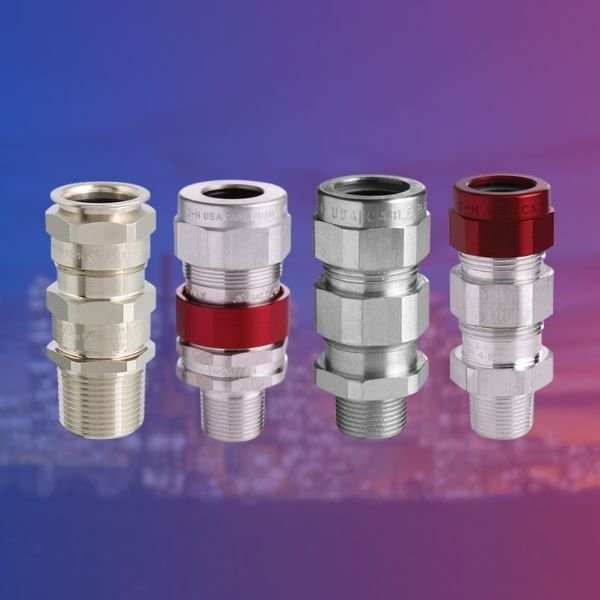
- Indirect Entry: Cables are usually connected via certified Ex d cable glands or through a barrier gland to ensure the integrity of the flame path is not compromised.
Where is Ex d Used? (Applications)
Type “d” protection is heavy and expensive compared to other methods (like Ex e or Ex i), but it is often the only option for sparking components that require high power. It is typically used in Zone 1 and Zone 2 environments.
Common Applications:
- Electric Motors: High-voltage motors in refineries often utilize Ex d frames.
- Switchgear and Circuit Breakers: Components that naturally create sparks or arcs during operation.
- Control Stations: Junction boxes containing relays, contactors, or fuses.
- Lighting: High-intensity discharge lamps where surface temperatures are high.
Maintenance: The Golden Rule
The most critical aspect of maintaining Ex d equipment is protecting the Flame Path.
- Never scratch the mating surfaces: A scratch on the flange (flame path) increases the gap, potentially allowing hot flame to escape and ignite the facility.
- Use correct grease: Non-hardening grease must be applied to prevent corrosion of the flame path, but it must not be painted over.
- Check the bolts: Missing or loose bolts compromise the mechanical strength required to contain the explosion pressure.
Conclusion
Teknik Proteksi “d” (Flameproof) remains the heavy-duty champion of hazardous area safety. By accepting that gas will enter and explosions may happen, Ex d uses simple physics—pressure containment and thermal transfer—to keep the external environment safe.
Understanding that these enclosures are designed to “breathe,” rather than seal, is the first step in properly selecting, installing, and maintaining equipment in the world’s most dangerous industrial zones.
Frequently Asked Questions
Q: Can I use standard waterproof (IP65) boxes in Zone 1?
A: No. A standard IP65 box will burst if an internal explosion occurs, causing a catastrophic fire. You must use certified Ex d (or other appropriate protection) enclosures.
Q: What is the difference between Ex d and Ex e?
A: Ex d (Flameproof) allows sparks but contains the explosion. Ex e (Increased Safety) prevents the spark from happening in the first place (used for terminals and non-sparking components).